




Quick answer: United issues Future Flight Credit (FFC) when you cancel a ticket or your fare drops, and it’s locked to you, valid 12 months from your original ticket date, and your new trip has to depart before that date, not just be booked before it. Electronic Travel Certificates (ETC) work differently: they’re compensation-based, transferable to anyone, and also run on a 12-month clock from issue date. United also has a third, separate option called TravelBank, a prepaid cash account that doesn’t work like either credit.
Most of the confusion around United’s credits comes down to one thing: people assume “booking before it expires” is enough. For an FFC, it isn’t. The date that actually matters is when your trip departs, not when you click confirm.
Future Flight Credit (FFC): The Basics
FFC is what you get when you cancel a United ticket or switch to a cheaper fare and there’s value left over. It’s tied to your MileagePlus account and the original traveler, so you can’t hand it off to someone else.
The expiration date runs from your original ticket’s purchase date, not from when you cancelled. This trips up more people than almost anything else in United’s credit system. If you bought a ticket in January and cancelled it in November, your FFC doesn’t get a fresh 12 months from November, it’s still counting from January.
The deadline is a travel date, not a booking date. Simply making a new reservation before your FFC expires doesn’t save it. Your outbound flight actually has to depart before the expiration date. On a round trip, only the outbound leg needs to depart in time; the return can happen after your FFC’s expiration date has technically passed.
Basic Economy tickets generally don’t generate FFCs in the first place, since those fares are non-refundable and non-changeable by design.
Electronic Travel Certificates (ETC): A Different Animal
ETCs are what United issues as compensation, typically for something that went wrong on the airline’s end. Unlike an FFC, an ETC can be used to book a flight for anyone, not just the person it was issued to, and multiple ETCs can generally be combined on one booking. Both credit types run on roughly a 12-month clock, but they don’t combine with each other, and an ETC follows a book-by date rather than a travel-by one.
TravelBank: United’s Third, Completely Separate Option
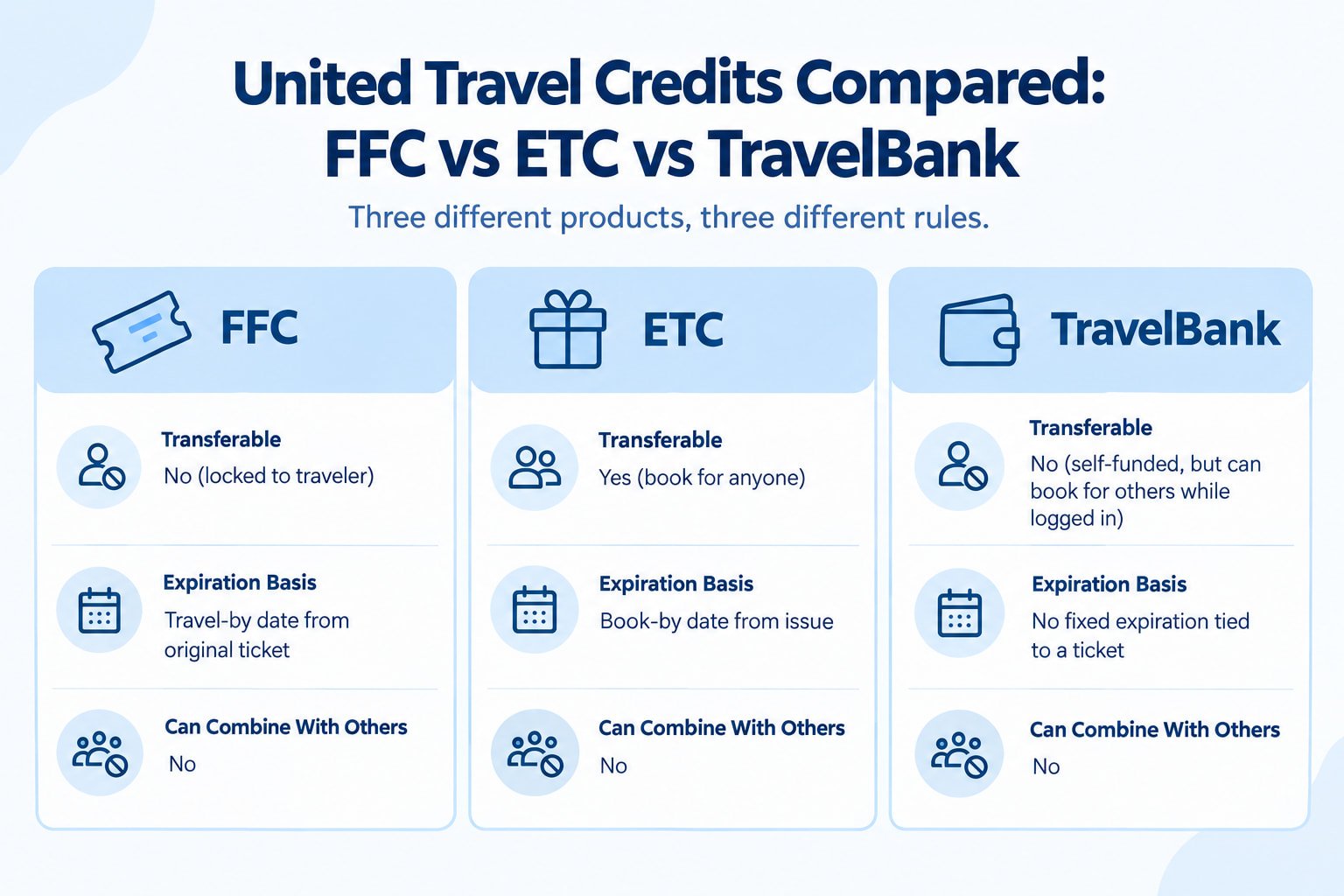
This is the piece most guides on this topic leave out entirely, and it works nothing like an FFC or ETC. TravelBank is a prepaid cash account tied to your MileagePlus profile. You fund it yourself, in amounts starting around $50 up to a daily limit, and then spend that balance on United or United Express flights, covering the base fare plus taxes and fees, even on Basic Economy.
A few things TravelBank can’t do: it doesn’t cover partner or Star Alliance flights, hotels, or car rentals, and you can’t use it to pay taxes and fees on a MileagePlus award ticket booked with miles. It also can’t be combined with an FFC, an ETC, or miles in the same transaction. You can, however, use your own TravelBank balance to book a ticket for someone else, as long as you’re the one logged in and making the purchase, which is different from how a straightforward FFC works.
If you’re deciding between letting a fare drop turn into an FFC versus proactively loading a TravelBank account, the practical difference is flexibility: TravelBank cash runs on its own five-year clock from each deposit, rather than the 12-month, single-ticket expiration an FFC carries, but it only ever works for United-operated flights.
Where to Find Your Credits
The most direct route is logging into your MileagePlus account, opening My Trips, and checking the Travel Bank & Credits or Future Flight Credit tab, which shows your balance, expiration date, and the ticket it came from.
If a credit doesn’t show up there, it’s often because the original booking wasn’t made while logged into your account. United’s travel credit look-up tool can help: enter your booking reference and last name to pull up the credit, along with the original ticket number from your confirmation email.
Using Multiple Credits Together
You can combine more than one FFC or ETC on a single booking, though there’s a practical cap on how many the online system will process at once, beyond which you’ll need customer service to apply the rest manually.
When you combine credits with different expiration dates, the combined credit typically follows the earliest of the dates involved, not the latest, so pay attention to which credits you’re using first if you’re holding several with different deadlines.
What FFC Can and Can’t Pay For
You can generally use FFC for: flights operated by United or United Express, itineraries booked directly with United even when a partner airline operates part of it, and any cabin class from Economy through First.
You generally can’t use FFC for: paying the taxes and fees on a MileagePlus award ticket, or post-purchase add-ons like Wi-Fi or extra baggage purchased separately from the fare itself.
If United Caused the Disruption, You’re Not Limited to a Credit
Everything above assumes a voluntary cancellation or a fare drop. If United cancels your flight or makes a significant schedule change, you’re generally entitled to a full refund to your original payment method, not just a credit, if you choose not to travel. Airlines sometimes offer a credit as the default option in this situation, but under U.S. Department of Transportation rules, a cash refund is what you’re entitled to ask for when the disruption is the airline’s fault.
Award Ticket Cancellations Work Differently From FFC
If you booked with MileagePlus miles rather than cash, cancelling before departure generally comes with no redeposit fee at all, your miles go back to your account, and any taxes paid in cash are refunded to your original payment method. This wasn’t always the case, but United removed standard redeposit fees for pre-departure award cancellations a few years back.
The one situation where a fee does apply is a no-show. If you don’t cancel and simply don’t fly, redepositing those miles afterward typically costs $125. That’s a meaningful gap between cancelling proactively and letting a booking lapse, so if your plans change on an award ticket, cancelling before departure rather than after is worth doing even if you’re not sure yet whether you’ll rebook.
FFC and a Few Other Practical Notes
Rebooking with FFC into a Basic Economy fare is technically allowed, but it comes with a catch: since Basic Economy is non-changeable, if your new plans fall through again, you generally lose that credit’s value entirely rather than getting another FFC out of it.
Credits are also tied to how you originally booked. If your ticket was purchased through a third-party travel agency rather than directly with United, redeeming the resulting credit may need to go through that same agency rather than United’s own website or app.
If your credit has already expired, don’t count on getting it reinstated. United generally does not bring back expired credits, and real reported cases, including serious medical situations, have been turned down. If you know in advance that a documented medical issue or similar circumstance will keep you from using a credit in time, contacting United well before the expiration date, with documentation ready, gives you a meaningfully better shot than asking after it’s already lapsed.
Frequently Asked Questions (FAQs)
How long does a United Future Flight Credit last?
12 months from your original ticket’s purchase date, not the date you cancelled. Your outbound flight needs to depart before that date.
Can I use my United credit for someone else?
FFCs are locked to the original traveler. ETCs can be used to book travel for someone else.
What happens to leftover credit if my new flight costs less?
United generally issues a new FFC for the remaining balance, keeping the same original expiration date as the credit it came from.
Can I combine my Future Flight Credit with MileagePlus miles?
No, FFCs and miles aren’t combinable in a single transaction.
What’s the difference between TravelBank and a Future Flight Credit?
TravelBank is cash you deposit yourself and spend on United or United Express flights, running on its own five-year clock per deposit rather than the 12-month, single-ticket window an FFC carries. An FFC comes from a cancellation or fare drop and is tied to that specific original ticket’s date.
Does United refund a canceled flight if the airline caused the disruption?
Generally yes. If United cancels or significantly changes your flight, you’re typically entitled to a full refund rather than being limited to a credit.
Is there a fee to cancel a United award ticket?
Not if you cancel before departure, that’s generally free. A no-show, where you don’t cancel and simply miss the flight, typically costs $125 to redeposit the miles afterward.
Can I use FFC to book a Basic Economy ticket?
Yes, but carefully. Basic Economy is non-changeable, so if those plans fall through too, you generally lose the credit’s value rather than getting another FFC back.
Can I get an expired United credit reinstated?
Generally no. United doesn’t typically bring back expired credits, even in documented hardship cases. Your best shot is contacting United before expiration, not after.
A Few Things People Get Wrong
- Assuming booking before the expiration date is enough. For an FFC, your flight actually needs to depart before that date, not just be reserved.
- Confusing the cancellation date with the expiration date. The clock starts from your original ticket’s purchase date, not when you cancelled.
- Letting an award ticket lapse into a no-show instead of cancelling it. That turns a free cancellation into a $125 redeposit fee.
- Assuming TravelBank works like an FFC. It’s cash you fund yourself, with different rules about what it can pay for and how it combines with other credits.
- Waiting until after a credit expires to ask for an exception. Reinstatement is rare even in genuine hardship cases. Reaching out before expiration gives you a real shot; asking after usually doesn’t.
Final Word
United’s credit system genuinely trips people up because it isn’t one product, it’s three: FFC, ETC, and TravelBank, each with its own rules about who can use it and when it actually expires. The single most important thing to remember is that an FFC’s deadline is about when your flight departs, not when you book it. Check the specific credit type and date on your MileagePlus account before assuming a general rule applies to your situation. If you’d rather have someone walk through your specific credits with you, the team at Xora Travel can help.
This guide is independent travel information and isn't affiliated with or endorsed by United Airlines. Policies, fees, and processing timelines can change, so always confirm the specifics of your own booking directly with the airline before making a decision.
Whether it's a cancellation, date change, name change, seat upgrade, or any other booking issue, our team can help you sort it out. Call us at +1-844-522-6968.